Indian classical music is one of the oldest living musical traditions in the world, passed down for centuries from teacher to student. It has two great branches: Hindustani music from North India (and Pakistan and Bangladesh), and Carnatic music from South India. Aimrec’s catalogue is almost entirely Hindustani, so that is the tradition this guide introduces.
You don’t need any musical training to enjoy it. A few ideas, raga, tala and the shape of a performance, will help you hear what the musicians are doing, and the albums suggested at the end are a good place to begin.
Raga: the melody
A raga is the melodic heart of Indian classical music. It is more than a scale: each raga has its own set of notes, its own way of ascending and descending, characteristic phrases, and an important note it returns to. Above all, it has a mood, from the calm devotion of Raga Yaman to the longing of Raga Bageshree.
In the Hindustani tradition, ragas are also linked to the time of day and the seasons. Bhairavi belongs to the morning, Yaman to the evening, Bihag to the night, and the Malhar ragas to the monsoon. A musician never plays a raga the same way twice; every performance is a new exploration within its rules.
Our Raga Guide introduces the ragas on Aimrec albums, grouped by their traditional time of day where one is given, with links to the recordings identified in our track lists.
Thaat: the parent scale
A thaat is a parent scale used to group Hindustani ragas by their notes. Musicologist Vishnu Narayan Bhatkhande organized ragas into ten widely used thaats. Each thaat is a seven-note framework, not a melody to perform. A raga may use fewer notes, take different paths up and down, and have phrases that give it a character of its own.
In the list below, shuddh means the natural form of a note, komal means lowered, and tivra means raised. Bilawal has all seven shuddh notes (Sa, Re, Ga, Ma, Pa, Dha and Ni). The other thaats are described by the notes they change from Bilawal:
- Bilawal: all seven notes shuddh.
- Kalyan: tivra Ma.
- Khamaj: komal Ni.
- Bhairav: komal Re and Dha.
- Poorvi: komal Re and Dha; tivra Ma.
- Marwa: komal Re; tivra Ma.
- Kafi: komal Ga and Ni.
- Asavari: komal Ga, Dha and Ni.
- Bhairavi: komal Re, Ga, Dha and Ni.
- Todi: komal Re, Ga and Dha; tivra Ma.
For an Aimrec example, Yaman belongs to Kalyan thaat, Bageshree to Kafi, and Bhairavi to Bhairavi. A thaat helps classify a raga, but it cannot tell you the raga’s full melody, mood or traditional time of day. Some ragas do not fit neatly into just one thaat.
Tala: the rhythm
Tala is the rhythmic cycle that holds the music together. Each tala has a fixed number of beats that repeat in a cycle, with the first beat, called sam, as the point where musicians meet again after their improvisations. Listeners often nod or clap on the sam.
The most common tala is Teental, a cycle of 16 beats. Others you will see on Aimrec albums include Ektal (12 beats), Jhaptal (10), Rupak (7), Deepchandi (14), Dadra (6) and Keherwa (8). The tabla, a pair of hand drums, keeps the cycle with a basic pattern called theka, then joins the soloist in rhythmic conversation.
Watch: an uthan, the opening of a tabla solo
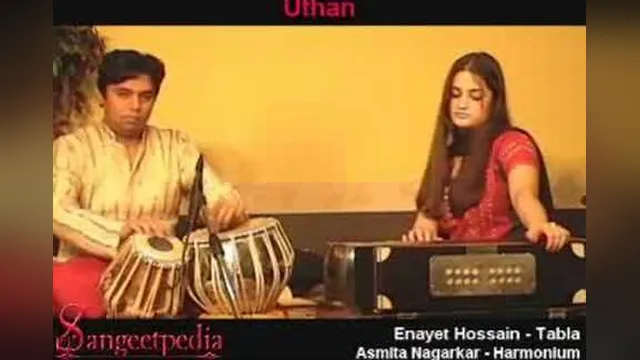 Play video: Uthan: the Opening of a Tabla Solo
Uthan: the Opening of a Tabla Solo
Enayet Hossain (tabla), Asmita Nagarkar (harmonium) · Sangeetpedia · 2008 · 0:43
Videos play in YouTube’s privacy-enhanced mode; nothing loads from YouTube until you press play.
How a performance unfolds
One common instrumental concert format grows slowly, like a story. Performances vary, and a recording may omit some of these stages.
It may begin with the alap: a slow, unaccompanied introduction in which the soloist reveals the raga note by note, with no fixed rhythm. In many instrumental performances the alap moves into the jor, where a steady pulse appears, and then the jhala, fast and brilliant, with rapid strokes on the drone strings.
The tabla may then enter with the gat, an instrumental composition set to a tala (in vocal music, a composition is often called a bandish). A slow vilambit gat may be followed by one in madhya (medium) or drut (fast) tempo, as the soloist and tabla player trade improvisations.
This is why many Aimrec albums list tracks such as “Alap, Jor, Jhala”, “Gat in Vilambit Teental” and “Gat in Drut Teental”: they can form stages of one raga performance.
The instruments and the voice
Indian classical music began with the voice, and singing (above all the khayal style) is still at its centre. The instruments imitate the voice’s slides and ornaments.
The sitar, a long-necked plucked instrument with sympathetic strings, is the best-known. The santoor is a hammered dulcimer from Kashmir with a shimmering, bell-like sound. The sarangi, played with a bow, is the instrument closest to the human voice. The bansuri is a bamboo flute. On Aimrec you will also hear rarer voices: the vichitra veena, the Indian slide guitar, and the violin and piano in duets.
Behind the music, a tanpura often plays a steady drone on the home note (Sa), and the tabla provides the rhythm. Our Indian Instruments page describes each one in more detail.
Lighter forms and duets
Alongside the great ragas, Indian music has lighter, more song-like forms that often close a concert. A thumri or dadra is a light-classical song, often romantic or devotional; a dhun is an instrumental piece based on a folk or light melody; a bhajan is a devotional song. Dadra is also the name of a six-beat tala: the song form and the rhythmic cycle are different things.
Watch: lighter forms from Sangeetpedia
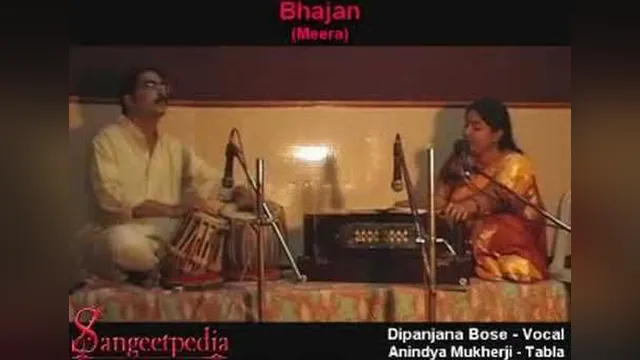 Play video: Meera Bhajan
Meera Bhajan
Dipanjana Bose (vocal), Anindya Mukherjee (tabla) · Sangeetpedia · 2008 · 3:13
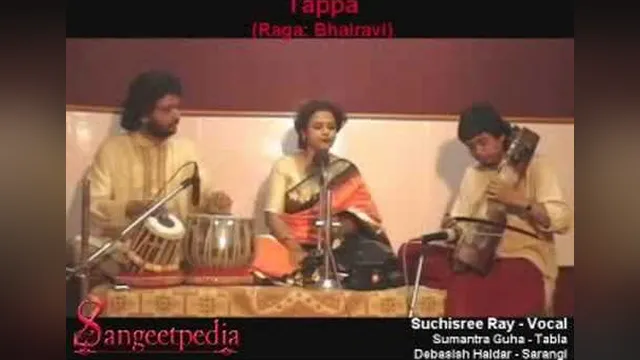 Play video: Tappa in Raga Bhairavi
Tappa in Raga Bhairavi
Suchisree Ray (vocal), Sumantra Guha (tabla), Debasish Haldar (sarangi) · Sangeetpedia · 2008 · 2:11
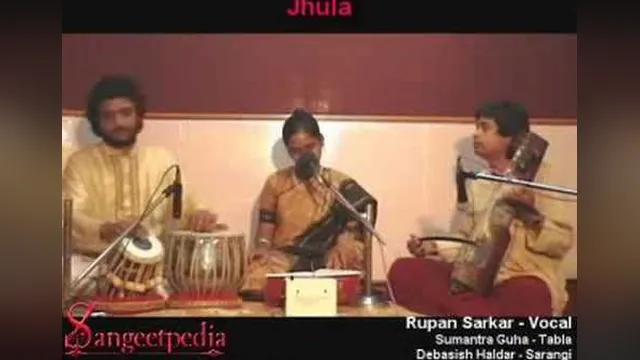 Play video: Jhula: a Monsoon Swing Song
Jhula: a Monsoon Swing Song
Rupan Sarkar (vocal), Sumantra Guha (tabla), Debasish Haldar (sarangi) · Sangeetpedia · 2008 · 2:17
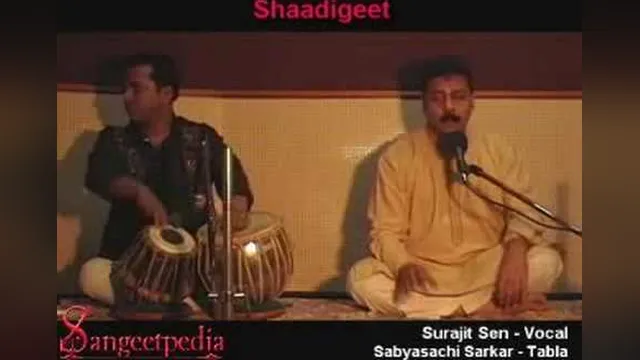 Play video: Shaadigeet: a Wedding Song
Shaadigeet: a Wedding Song
Surajit Sen (vocal), Sabyasachi Sarkar (tabla) · Sangeetpedia · 2008 · 3:51
Videos play in YouTube’s privacy-enhanced mode; nothing loads from YouTube until you press play.
The uthan and these lighter forms are excerpts from Sangeetpedia, our sister site and encyclopedia of Indian music, now being rebuilt as an online educational platform at sangeetpedia.com. Its official launch is planned for the fourth quarter of 2027.
A jugalbandi is a duet between two soloists, such as sitar and sarangi, sitar and violin, or sitar and flute, who share the raga and answer each other’s phrases. Aimrec’s Soulful Duets series is built around this idea. Explore Aimrec’s jugalbandi recordings.
Gharanas: schools and family traditions
Musicians learn from a guru, often a parent, through years of close teaching. Over generations, these lineages became gharanas: schools with their own style and repertoire. You will see them in our artist biographies, for example the Imdadkhani (or Etawah) gharana of sitar, the family of Ustad Vilayat Khan, his sons and Ustad Shahid Parvez Khan; the Kirana and Agra gharanas of singing, and the Farrukhabad and Benaras gharanas of tabla.
Where to start listening
Two Aimrec collections are good starting points:
Introduction to Indian Music, Vol. 1: eighteen performances of the great ragas by masters including Ustad Vilayat Khan, Ustad Zakir Hussain, Ustad Shujaat Khan and Ustad Shahid Parvez Khan.
Introduction to Indian Music, Vol. 2: the lighter side, with thumris, dhuns and folk melodies on sitar, santoor, bansuri, sarangi, violin, slide guitar and voice.
Then choose one complete raga on each instrument:
- Sitar: Yaman (Hidayat Khan), or Excellence on the Sitar (Ustad Shujaat Khan).
- Santoor: The Exotic Santoor (Pandit Tarun Bhattacharya).
- Bansuri: Live in Concert (Ronu Majumdar), or Mystical Breath (Deepak Ram).
- Voice: Masters of Music (Ustad Rashid Khan).
- Sarangi: The Emotive Sarangi (Zohaib Hassan).
- A duet: Soulful Duets (Hidayat Khan and Dilshad Khan).
- For the morning: Ragas of Dawn (Pandit Manilal Nag).
And if you come from jazz or world music, Woven Paths by Melodic Intersect shows how these traditions meet.